NeXuS Zombie Apocalypse Mode — Survival Communications
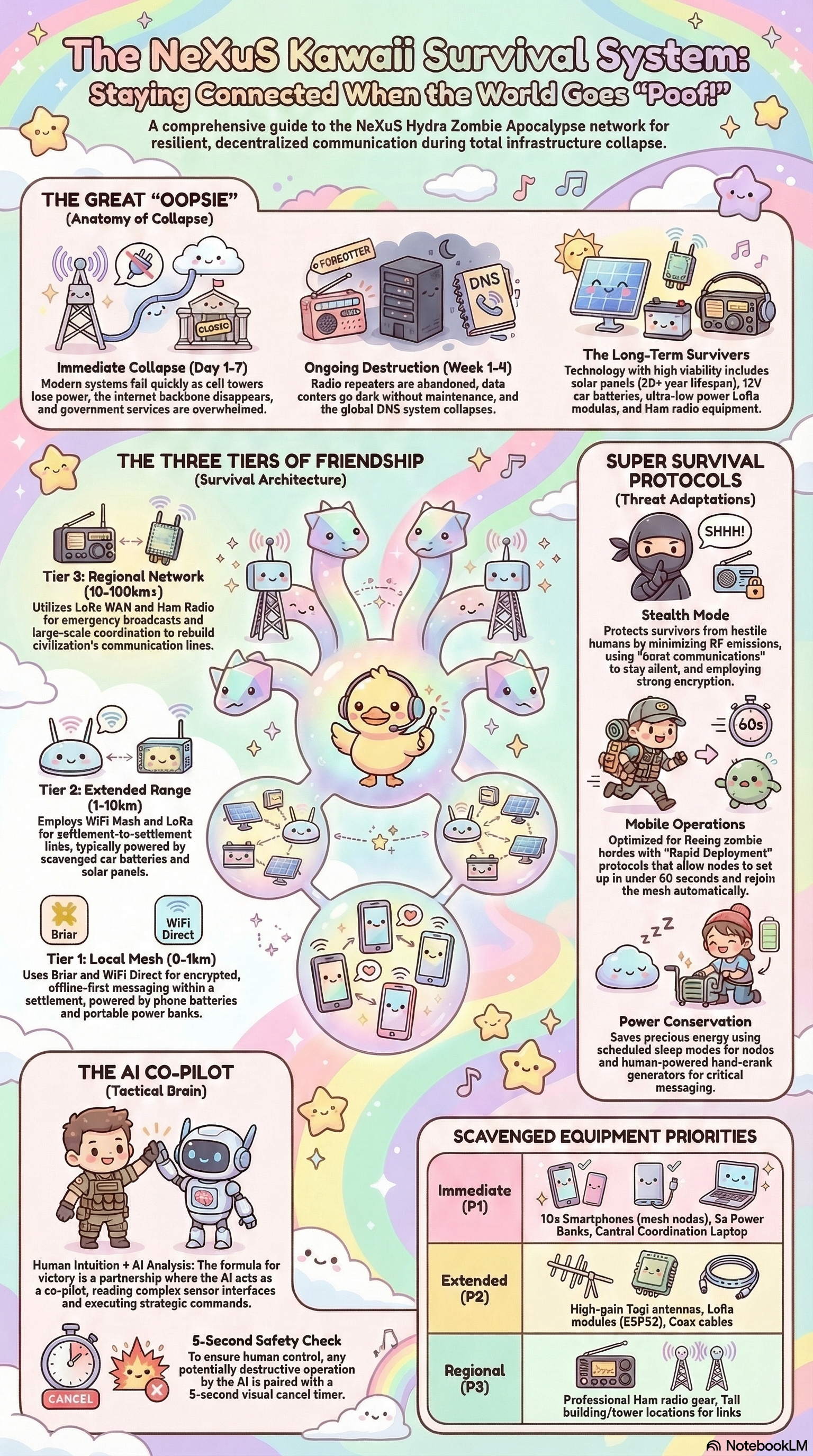
The NeXuS Zombie Apocalypse scenario is a specialized emergency network architecture designed for worst-case infrastructure failure . This "deep dive" analyzes the conditions of collapse, the tiered technical response, and the specific adaptations required for survival. 🌍 The Anatomy of Infrastructure Collapse The scenario assumes a total breakdown of modern systems across two primary stages:
Immediate Collapse (Day 1-7): This stage involves the total failure of cell towers due to traffic and power loss, the disappearance of the internet backbone, and the end of government services
. Ongoing Destruction (Week 1-4): During this period, radio repeaters are abandoned or destroyed, data centers (AWS/Google) go dark without maintenance, and the global DNS system collapses . What Survives: Technology with long-term viability includes solar panels (20+ year lifespan), car batteries for 12V DC power, LoRa modules due to ultra-low power consumption, and Ham radio equipment
.
🦆 The NeXuS Tiered Survival Architecture To maintain humanity's connection, NeXuS implements a three-tier mesh strategy:
Tier 1: Local Mesh (0-1km): Uses Briar and WiFi Direct for encrypted, offline-first messaging within a settlement
. It relies on phone batteries and portable power banks . Tier 2: Extended Range (1-10km): Employs WiFi Mesh and LoRa for settlement-to-settlement links . These nodes are typically powered by scavenged car batteries and solar panels . Tier 3: Regional Network (10-100km+): Utilizes LoRa WAN and Ham Radio for emergency broadcasts and large-scale coordination . This tier is essential for rebuilding civilization's communication lines
.
🧟♂️ Threat-Specific Adaptations NeXuS includes protocols designed for the specific dangers of a post-collapse world:
Stealth Mode: Designed to avoid hostile humans by minimizing RF emissions, using burst communications to stay silent between messages, and employing strong encryption
. Mobile Operations: Optimized for fleeing zombie hordes with a "Rapid Deployment" protocol that allows nodes to set up in under 60 seconds and rejoin the mesh automatically . Power Conservation: Nodes use scheduled sleep modes and "Human-powered" hand-crank generators for critical, priority-only messaging
.
🛠️ Scavenged Equipment Priorities Implementation is divided into three priority phases for hardware collection:
Immediate (P1): 10x smartphones (mesh nodes), 5x power banks, and at least one central laptop for coordination
. Extended (P2): High-gain Yagi antennas, LoRa modules (ESP32), and coax cables . Regional (P3): Professional Ham gear and tall building/tower locations for point-to-point links
.
🧠 The Role of AI in Survival A key finding in the NeXuS project is that human intuition paired with AI tactical analysis is the formula for "Zombie Apocalypse Victory" . AI can serve as a co-pilot by reading complex game or sensor interfaces and executing strategic commands via terminal automation, a theory proven during historic AI-human gaming collaborations . Analogy: The Digital Constellation In a total blackout, survivors are like individual stars that have lost the sun (the Internet). The NeXuS survival architecture acts as the gravity that pulls these scattered points together, allowing them to form a new, independent constellation that can guide others through the dark .